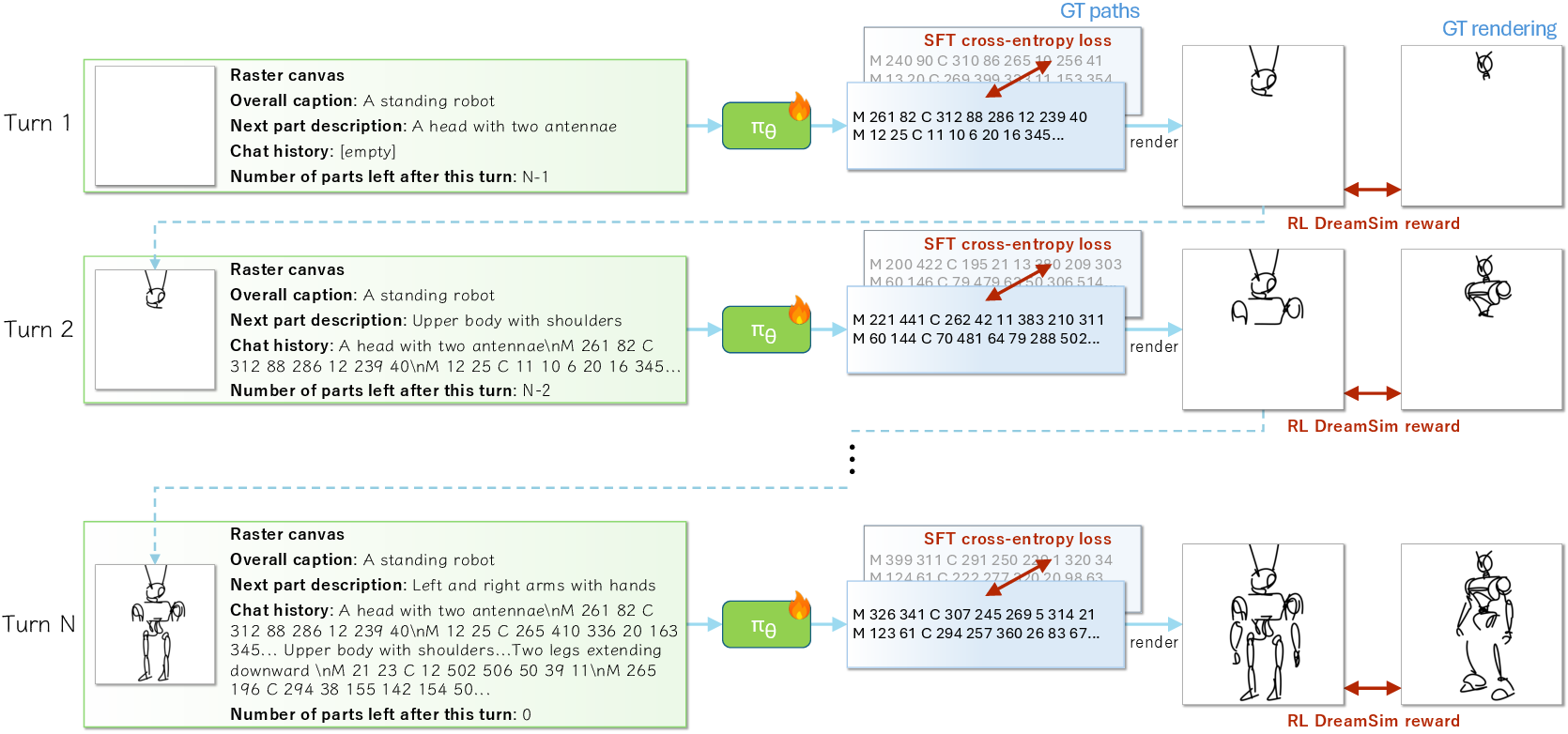
The core idea: the agent draws a part, looks at the canvas, reads the next text instruction, and draws again. This loop gives you free editability — swap out any part's strokes, regenerate with a new description, and the rest stays intact.
TL;DR
We train a VLM agent that draws vector sketches one part at a time. It's powered by three new ingredients: a generic VLM-driven annotation pipeline that labels semantic parts in any vector sketch, ControlSketch-Part — a part-annotated sketch dataset — and multi-turn process-reward GRPO, an RL algorithm that rewards the agent at every intermediate step.
Automated part annotation
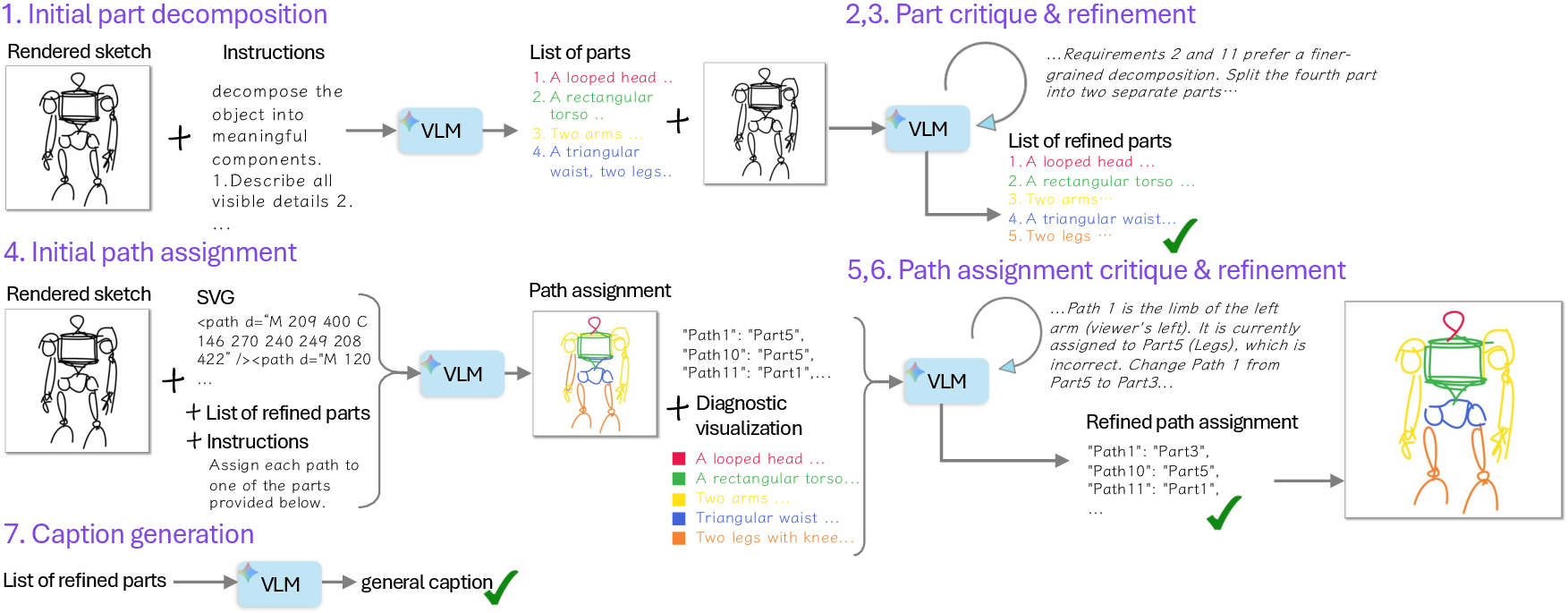
A generic propose-critique-refine loop that splits any vector sketch into semantic parts and assigns every SVG path to a part.
ControlSketch-Part
High-quality part-annotated sketches with captions, part descriptions, and path-to-part maps — plus a multi-turn benchmark.
Multi-turn process-reward GRPO
Dense per-step DreamSim rewards close the gap between oracle intermediate states and self-generated ones.
How it works
Three ingredients. One agent that actually draws one part at a time.
A pipeline that labels parts automatically
A VLM loops through propose → critique → refine → assign paths → verify with a color-coded diagnostic. Works on any vector sketch dataset.
A dataset: ControlSketch-Part
35K high-quality sketches, each enriched with a short caption, per-part descriptions, and a full path-to-part map.

Training: SFT then multi-turn process-reward GRPO
Qwen3-VL-30B-A3B + LoRA. Each RL turn draws one part; DreamSim on the partial render gives dense, per-step rewards that close the oracle-vs-self-generation gap.
Editable by design
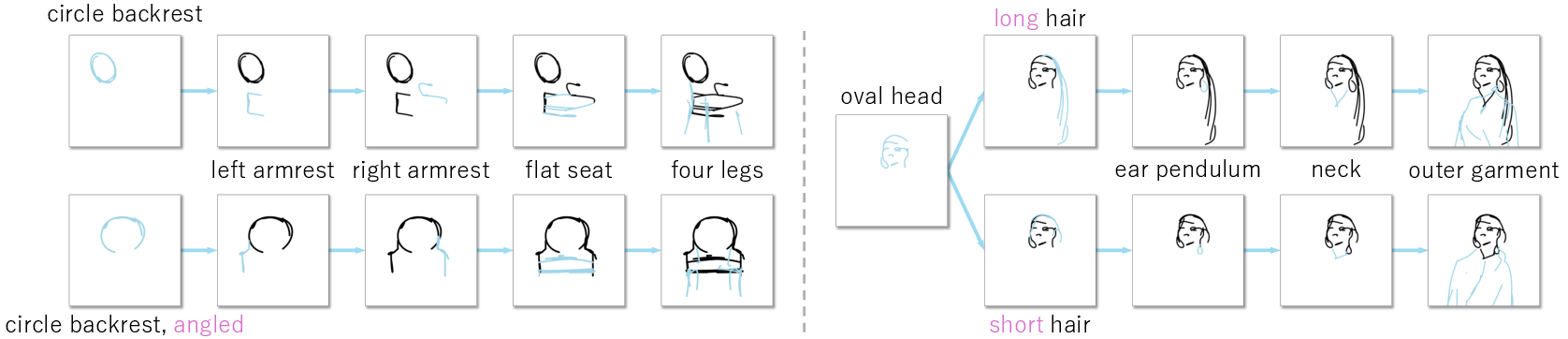
Part-level edit control.
Every stroke is tagged with a part, so you can swap, remove, or regenerate any region with a new text description — without redoing the whole sketch.
Results
See it side-by-side
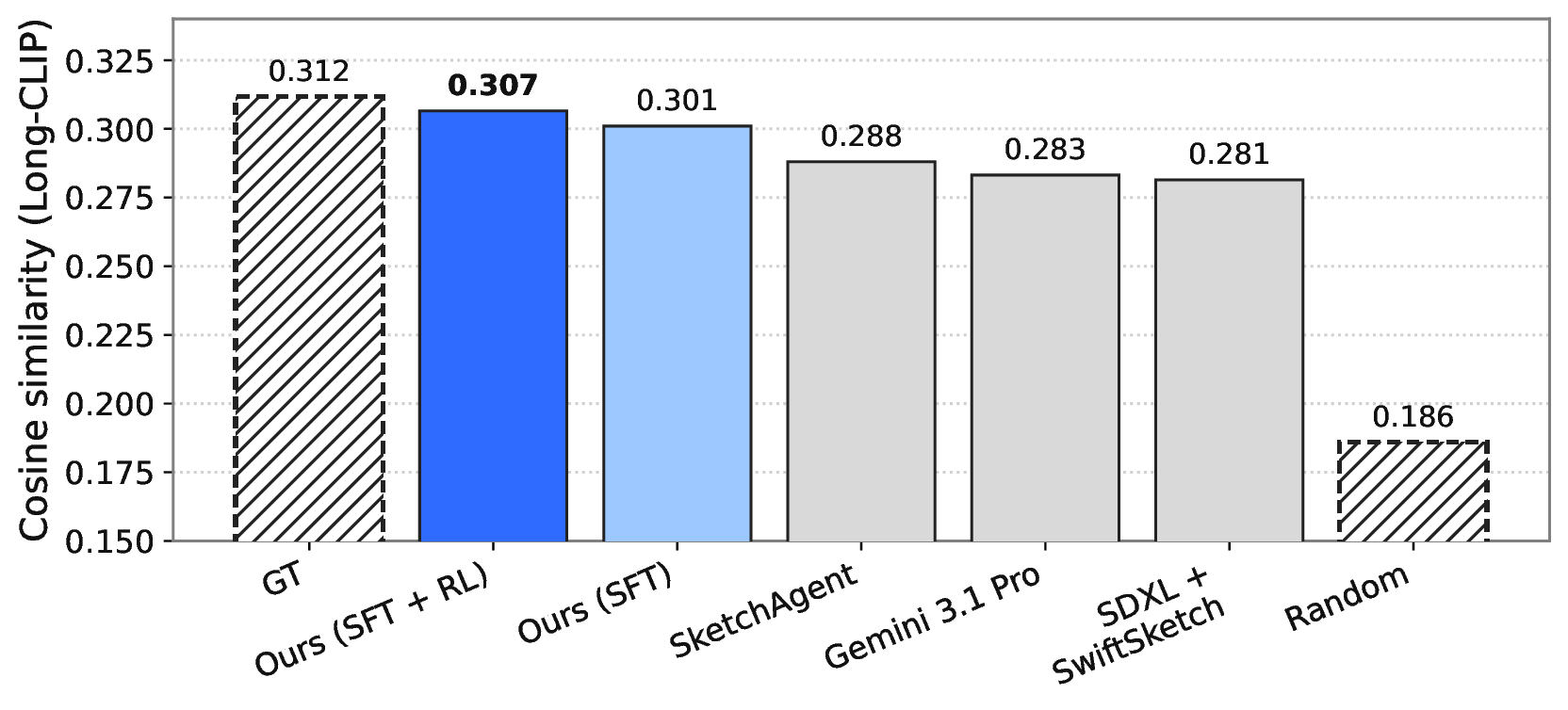
By the numbers

BibTeX
@inproceedings{du2026teaching,
title={Teaching an agent to sketch one part at a time},
author={Du, Xiaodan and Xu, Ruize and Yunis, David and Vinker, Yael and Shakhnarovich, Greg},
booktitle={European Conference on Computer Vision},
pages={248--265},
year={2026},
organization={Springer}
}